Cocoa · Market
The EU's Deforestation Regulation Arrived on Top of the Price Spike
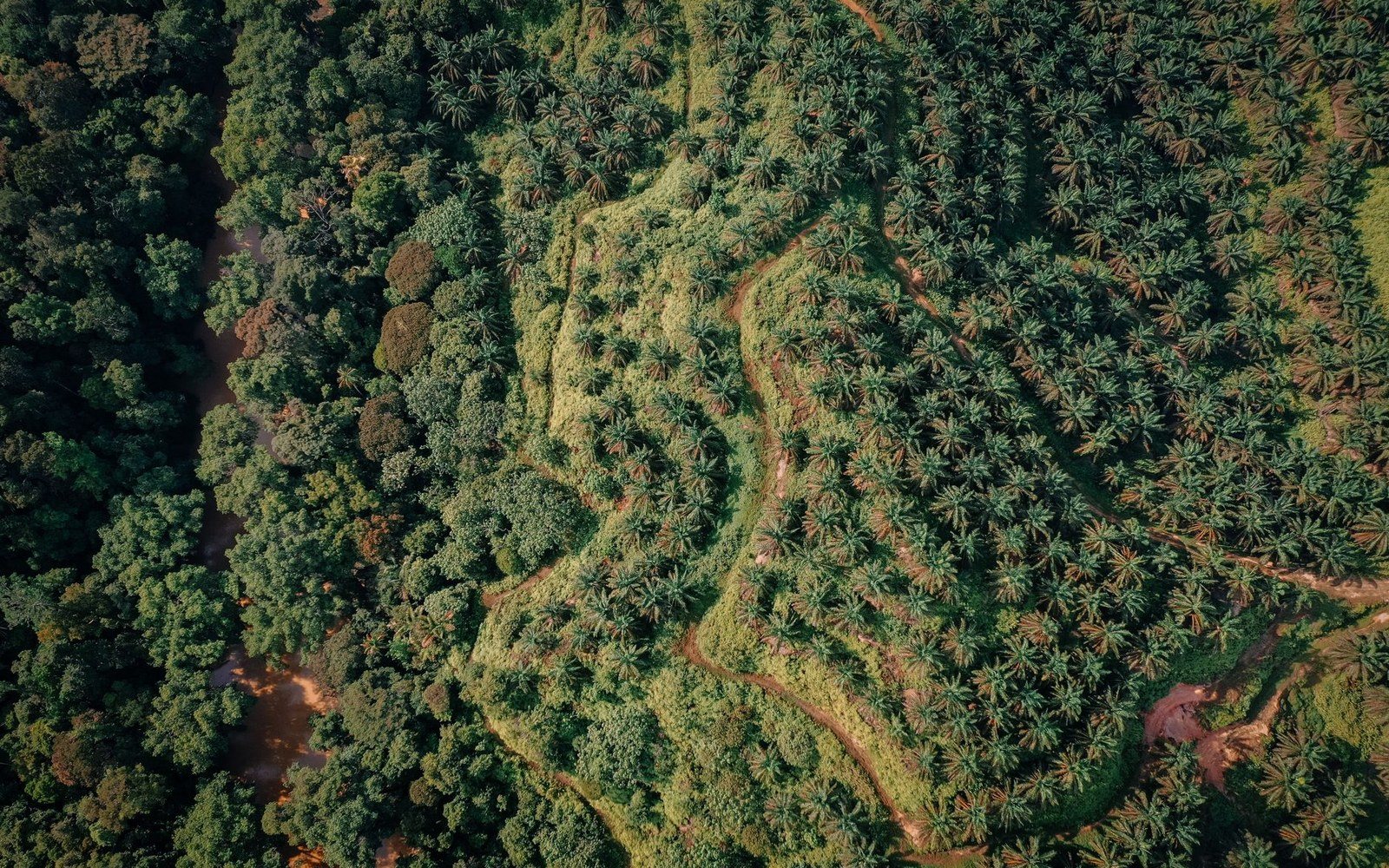 Plate 20
The regulation turns this boundary into paperwork: every consignment has to be traced to the plot it grew on.
Photo: Pok Rie / Pexels
A law designed to protect forests landed in the middle of the worst cocoa price crisis in decades — and the combination is reshaping how beans move from West Africa to European shelves.
What the Regulation Requires
Regulation (EU) 2023/1115 ↗, which entered into force in June 2023, prohibits the sale on the EU market of cocoa — and a handful of other commodities, including cattle, soy, palm oil, and timber — if it was produced on land deforested after 31 December 2020. The requirement is not a label or a certification; it is a legal gate. Any operator placing cocoa or cocoa-derived products on the EU market must carry due-diligence documentation showing that every lot can be traced to a specific plot of land, georeferenced to GPS coordinates, and that the plot was under forest cover on that baseline date.
For a supply chain that runs through Côte d'Ivoire and Ghana — the two countries that together supply roughly two-thirds of the world's cocoa — this is structurally demanding. Most cocoa moves through aggregators and cooperatives that pool beans from hundreds of smallholder farmers, each working two or three hectares. Plot-level geolocation at scale requires mapping infrastructure, farmer registration systems, and field-verification capacity that did not widely exist before the regulation passed.
The December 2024 Delay
The original compliance deadline for large operators was December 2024. In October 2024, the European Commission proposed a twelve-month extension, pushing the date to December 2025 for large companies and June 2026 for small and medium enterprises. The formal decision followed swiftly, with the amended timeline adopted into law before the original deadline passed.

Where the spike became visible: the same shelf and the same brands, with less weight behind the price label.
Photo: Nothing Ahead / Pexels

The seeds taste of almost nothing at this stage. Four days of fermentation in that white pulp is what makes them taste of chocolate.
Photo: Aaron H Ch / Pexels
The delay was partly a concession to trading partners — the EU received formal objections from a range of cocoa-producing and -exporting governments — and partly a practical acknowledgement that the classification system the regulation depends on (a country-level and operator-level risk tier, to be published by the Commission) had not been finalised. Without knowing which countries fall into which risk tier, operators could not complete their due-diligence frameworks to the regulation's standard.
The delay did not suspend the regulation. It moved the enforcement date. Every legal requirement remains intact, and operators who used the extra year to build compliant traceability systems will have a structural advantage when enforcement begins.
What It Means in Practice
The cost of compliance lands unevenly. Large processors — Barry Callebaut, Cargill, and Olam International among them — have the capital and the existing sustainability programmes to absorb the mapping work, even if it is expensive. Smaller European importers and chocolatiers sourcing directly from origin face a harder calculus: the documentation burden is identical regardless of volume, so it weighs more heavily per kilogram.
For farmers in Côte d'Ivoire and Ghana, the pressure is indirect but real. A cooperative that cannot produce georeferenced lot data to the regulation's standard may find its beans excluded from the EU supply chain, redirected to markets with lower traceability requirements, and priced accordingly. The risk is that EUDR compliance becomes another layer of value extraction — absorbed by the chain, not returned to the farm.
That risk sits on top of two consecutive below-average harvests in West Africa and cocoa futures that spiked past ten thousand dollars a tonne on ICE Futures during 2024. The International Cocoa Organization has tracked both the supply shock and the price consequences; the regulation adds a compliance cost to a market already under acute pressure.
None of that makes the underlying purpose wrong. Forest loss in the cocoa belt is documented and ongoing, and a legal baseline that ties market access to verified land use is one of the few instruments with teeth. What the December 2024 delay bought was time — for systems to be built, for classifications to be published, and for a supply chain under extraordinary strain to prepare for a structural change that, delayed or not, is coming.
The supply chains the regulation reaches: Côte d’Ivoire and Ghana shaded at their real coordinates, with Nigeria, Cameroon and São Tomé marked alongside them.
Geometry: project map kit
More from Cocoa